Sunday, November 13, 2011
Morality vs. the planet
Nerding out - will be trying to trace foods and the amount of energy they require to produce to figure out how much energy does it take to make our dinner. And what is the real cost.

No, I don't want to eat my cat/dog for dinner...
To address the pictures of cute cats and dogs on vegan websites that pose the question - if it's OK to eat farmed animals, why not them?
When I started to think the idea through - OK, lets say we outlaw meat or collectively magically decided to all be vegan- but then what? What happens to all the farm animals? Release into the wild? Well we all know that will just make the population of every predator go up. Wolves, coyotes, bears will flourish on easy meals.
So humans are sentient beings, cows are sentient and so are wolves. If we see wolves hunt down that cow, do we interfere? Humanely slaughter it for the wolves? Because from watching Animal Planet, very few predators were concerned with pain of their prey. How do we, as humans, participate in the natural world, when a lot of it is quite violent? We make a choice to go to Whole Foods, while a wolf or a bear ... doesn't really have the same options.
I guess it made me wonder if basing my diet and a way of life on just "well it's wrong to eat them because they feel pain" is a good idea. Because everything tried to eat something else living.
But then again, I can't compare going to a grocery store to hunting prey in the wilderness. After all, I have free will and intelligence to decide what I will have for dinner. I live in a place where options are essentially limitless. I live in a metropolitan area, there is everything from farmer's markets to gourmet butchers to ethnic food of every kind. A real farm is about 2 hours away if I choose to go that route.
So I am as removed from wilderness and hunting my food as one gets, though I am sure I could pay someone to take me hunting. So what am I suppose to do?
I guess I have decided to use my place in the food chain and my ability to think critically as to how do I fit in to this world puzzle.
I am trying to compare the fate of fowl and prey animals in the wild to the slaughter of animals on small family farms. And while in the wild the predators will start eating their prey as soon as they sink their teeth in it, we humans tend to bring the suffering of an animal we are about to eat to an end as soon as possible.
If deciding between living in the wild and being eaten almost alive vs. being fattened up and slaughtered painlessly later.... I guess I would pick the latter...
Many vegans will say, well neither. But that means living in the wild where natural death is not as neat and tidy - who is comfortable in releases massive amounts of animals who have had their survival instincts bred out of them into the wild to a certain death?
Or taking it upon yourself euthanasia of animals that can't fend for themselves to "ease suffering" of natural living- mainly anything domesticated like chickens, cows or pigs. I don't think I am comfortable with that idea... Maybe that's the mutual relationship that early farm societies developed and factory farms bastardized.
Well, would I eat my cat then? No. My cat is not a product of thousands of years of domestication and selective breeding. He's kind of bony. And what a Western world thing to ask! There are countries they eat dogs, snakes, lizards and insects and some that don't eat cows or pigs. We all make choices based on our own reasoning and our environment. Cute puppy or curious piglet.
I decided to be vegan (at least for a while) not because I swayed by the argument that there was something similar between chicken and my cat. I am trying to make a rational, reasoned decision in a vast sea of valid and ridiculous opinions. It's gonna be interesting one way or another!
When I started to think the idea through - OK, lets say we outlaw meat or collectively magically decided to all be vegan- but then what? What happens to all the farm animals? Release into the wild? Well we all know that will just make the population of every predator go up. Wolves, coyotes, bears will flourish on easy meals.
So humans are sentient beings, cows are sentient and so are wolves. If we see wolves hunt down that cow, do we interfere? Humanely slaughter it for the wolves? Because from watching Animal Planet, very few predators were concerned with pain of their prey. How do we, as humans, participate in the natural world, when a lot of it is quite violent? We make a choice to go to Whole Foods, while a wolf or a bear ... doesn't really have the same options.
I guess it made me wonder if basing my diet and a way of life on just "well it's wrong to eat them because they feel pain" is a good idea. Because everything tried to eat something else living.
But then again, I can't compare going to a grocery store to hunting prey in the wilderness. After all, I have free will and intelligence to decide what I will have for dinner. I live in a place where options are essentially limitless. I live in a metropolitan area, there is everything from farmer's markets to gourmet butchers to ethnic food of every kind. A real farm is about 2 hours away if I choose to go that route.
So I am as removed from wilderness and hunting my food as one gets, though I am sure I could pay someone to take me hunting. So what am I suppose to do?
I guess I have decided to use my place in the food chain and my ability to think critically as to how do I fit in to this world puzzle.
I am trying to compare the fate of fowl and prey animals in the wild to the slaughter of animals on small family farms. And while in the wild the predators will start eating their prey as soon as they sink their teeth in it, we humans tend to bring the suffering of an animal we are about to eat to an end as soon as possible.
If deciding between living in the wild and being eaten almost alive vs. being fattened up and slaughtered painlessly later.... I guess I would pick the latter...
Many vegans will say, well neither. But that means living in the wild where natural death is not as neat and tidy - who is comfortable in releases massive amounts of animals who have had their survival instincts bred out of them into the wild to a certain death?
Or taking it upon yourself euthanasia of animals that can't fend for themselves to "ease suffering" of natural living- mainly anything domesticated like chickens, cows or pigs. I don't think I am comfortable with that idea... Maybe that's the mutual relationship that early farm societies developed and factory farms bastardized.
Well, would I eat my cat then? No. My cat is not a product of thousands of years of domestication and selective breeding. He's kind of bony. And what a Western world thing to ask! There are countries they eat dogs, snakes, lizards and insects and some that don't eat cows or pigs. We all make choices based on our own reasoning and our environment. Cute puppy or curious piglet.
I decided to be vegan (at least for a while) not because I swayed by the argument that there was something similar between chicken and my cat. I am trying to make a rational, reasoned decision in a vast sea of valid and ridiculous opinions. It's gonna be interesting one way or another!
The tyranny of choice
I wasn't going to use that title...
I remember it from my Political Science professor whose second stint as a dad was about 20 years later after his first child. He pointed out that choosing dipers back then was easy and involved about 2 types. Today the choices are limitless, especially if you consider online ordering. And of course you want to make the right choice for your child so any choice involving something precious to you will cause a whole lot of anxiety.
I didn't realize this until I decided to pay attention to what I eat and what I buy. I wanted to do what was best for the planet. I didn't realize it would get so complicated.
While trying to decide on a farm-raised, grass fed meat - which one is better. Whole Foods has a chart and a ranking system which starts at 1 and goes to about 6 depending on how animal was treated but what does that mean?! Is one better than the usual factory farm or about the same? The meat is sometimes 7 times the expense than the grocery store - so how much better is this flesh anyways? In addition to deciding on factory farmed vs. responsibly farmed there is now a scale - how responsibly farmed do you want your animal to be? And if you add to the mix terms that mean nothing in terms of FDA standards - like "free range" or "natural" you are stuck in a perpetual dilemma of possibly making the wrong choice.
By offering so many choices Whole Foods is using a used car salesman technique - present as many choices as possible to confuse and exhaust the customer. After a while you just buy stuff 'cause it's from Whole Foods...
I am always amused by the amount of non-hybrid SUVs in the parking lot. It's like people bought this illusion that they are "helping" by shopping at Whole Foods. And while the store peddles Burt's Bees made by Clorox and icecreams made by Unilever, and some of the worst pet food around under the Paul Newman's brand - the warm glow of their green logo is suppose to make us feel better.
And for a while it was enough for me. But after realizing that Organic and Family Farmed has become big business terms (mainly through Omnivore's Dilemma) I am not sure anymore. I guess I can go to Trader Joe's but isn't it just the same but smaller and cheaper version with a gimmick and Hawaiian shirts?
All these stores and businesses started out trying to change the consumer world through better business practices and in return ended up being swallowed up by the system and spat out as just another product. Burt's Bees - started by hippies, now owned by Clorox. Ben and Jerry's - now owned by Unilever. Whole Foods - now so big it resembles organic Walmart rather then a wholesome alternative. Are all businesses who strive to change our consumer habits bound to just be absorbed into the big business quick sand? There are hopeful reminders that it doesn't have to be like that - Organic Valley milk that said no to Walmart.
But how many are there, how many can withstand the pressure of assimilation due to demand or financial needs?
And then again, what do you choose? Do you trust the label? Do you know what you are buying and is it really better for the environment? And how much research can you really do? How much time you have to sift through hundreds of labels with thousands of claims?
I am hoping to analyse energy use in the next post. I am hoping to figure out what is better for our planet, what requires more energy what requires less. What is the true cost of that meal you making for dinner. It might take me a while and will most likely be a running research project.
A great breakdown of some of the pieces in the study about farmland and reducing CO2 emissions. As well as how to turn a science study into propaganda...
http://veganskeptic.blogspot.com/2010/11/being-vegan-is-worse-for-environment.html
I remember it from my Political Science professor whose second stint as a dad was about 20 years later after his first child. He pointed out that choosing dipers back then was easy and involved about 2 types. Today the choices are limitless, especially if you consider online ordering. And of course you want to make the right choice for your child so any choice involving something precious to you will cause a whole lot of anxiety.
I didn't realize this until I decided to pay attention to what I eat and what I buy. I wanted to do what was best for the planet. I didn't realize it would get so complicated.
While trying to decide on a farm-raised, grass fed meat - which one is better. Whole Foods has a chart and a ranking system which starts at 1 and goes to about 6 depending on how animal was treated but what does that mean?! Is one better than the usual factory farm or about the same? The meat is sometimes 7 times the expense than the grocery store - so how much better is this flesh anyways? In addition to deciding on factory farmed vs. responsibly farmed there is now a scale - how responsibly farmed do you want your animal to be? And if you add to the mix terms that mean nothing in terms of FDA standards - like "free range" or "natural" you are stuck in a perpetual dilemma of possibly making the wrong choice.
By offering so many choices Whole Foods is using a used car salesman technique - present as many choices as possible to confuse and exhaust the customer. After a while you just buy stuff 'cause it's from Whole Foods...
I am always amused by the amount of non-hybrid SUVs in the parking lot. It's like people bought this illusion that they are "helping" by shopping at Whole Foods. And while the store peddles Burt's Bees made by Clorox and icecreams made by Unilever, and some of the worst pet food around under the Paul Newman's brand - the warm glow of their green logo is suppose to make us feel better.
And for a while it was enough for me. But after realizing that Organic and Family Farmed has become big business terms (mainly through Omnivore's Dilemma) I am not sure anymore. I guess I can go to Trader Joe's but isn't it just the same but smaller and cheaper version with a gimmick and Hawaiian shirts?
All these stores and businesses started out trying to change the consumer world through better business practices and in return ended up being swallowed up by the system and spat out as just another product. Burt's Bees - started by hippies, now owned by Clorox. Ben and Jerry's - now owned by Unilever. Whole Foods - now so big it resembles organic Walmart rather then a wholesome alternative. Are all businesses who strive to change our consumer habits bound to just be absorbed into the big business quick sand? There are hopeful reminders that it doesn't have to be like that - Organic Valley milk that said no to Walmart.
But how many are there, how many can withstand the pressure of assimilation due to demand or financial needs?
And then again, what do you choose? Do you trust the label? Do you know what you are buying and is it really better for the environment? And how much research can you really do? How much time you have to sift through hundreds of labels with thousands of claims?
I am hoping to analyse energy use in the next post. I am hoping to figure out what is better for our planet, what requires more energy what requires less. What is the true cost of that meal you making for dinner. It might take me a while and will most likely be a running research project.
A great breakdown of some of the pieces in the study about farmland and reducing CO2 emissions. As well as how to turn a science study into propaganda...
http://veganskeptic.blogspot.com/2010/11/being-vegan-is-worse-for-environment.html
Saturday, November 5, 2011
Background... (since when do I have time for a blog?)
I have been introducing my self as "failed vegan" a few times when my diet comes in question when I but soy ice cream, fake lunch meat, or ask if anyone wants to go to Chicago Diner so that I can have their amazing vegan Gyros sandwich.
I have been "omnivoring" for past 3 years or so after dropping the vegetarian diet I had for close to 12 years, one of those years has been a vegan year. I became a vegetarian in 7th grade after reading about animal suffering in a book randomly checked out from the library. A loner, unpopular immigrant child I loved animals more than people anyways. To the horrors of my very meat eating Eastern European family their little oddball decided not to eat the staple of the family diet - meat. Meat was fried, boiled, salted, smoked and baked. Meat was in everything and everywhere. A newly inherited tradition of Thanksgiving revolved around large quantity of meat already present in Eastern European family gatherings with an addition of a large turkey now as well. Sandwiches were rarely made without smoked ham or salami.
I guess I never really cared about what people thought of me. I had no problems telling horrified and confused relatives that I decided that meat is out of my diet due to my concern for farm animals. I was tempted sometimes of course, but determined to not give in.
In 7th grade science fair I presented a poster about how animal experiments are cruel and sometimes not very useful. This was before internet access for me so I had a list of citations from books found in the library. My poster had copies of pictures of tortured animals. I was a little kid who no one could really figure out. Because I looked weird, smelled weird, spoke a weird language and wore clothes that were 10 years out of fashion in United States, not eating what everyone else was didn't make me any more friends. Still though I carried on through grades 6-8 with highschool being slightly better. I had more choices over my food there, even if most lunches it consisted of cheese pizza and fries. I was friends with the weird kids so having a different diet wasn't that much of a biggie.
A year of vegan diet though presented some issues - caloric intake. I was on the swim team as well as orchestra and I would run on weekends. At some points I also did Judo - a very physically demanding martial art. All of these activities as well as a growing body required food and nutrition and calories. It wasn't the weight or how I looked it was more how I felt. I felt tired and cold all the time. I wanted to eat all the time which meant I had to eat whatever was around the house which was usually not that healthy. The fact that potato chips are vegan doesn't make them that great as a snack.
Another factor was that even with fake meat, I realized that dairy was in everything. Everything! Some breads, some vegetarian fake meats, and so on. And sometimes it wasn't even called dairy - you had to look it up on a chart to see what that derivative from dairy was. Casein was just one of many things that was not vegan. After not being able to do it for more than a year, I went back to vegetarian. I realized that I made myself intolerant to milk however. After drinking frozen coffee beverage with milk in it, my insides wanted to kill me.
Not being a fan of milk anyways, I gladly embraced soy milk and later almond milk. To me, it still tastes way better even though I could take some lactaid to allow me to drink it without consequences.
College was not an issue as cafeteria and later my autonomy in the grocery store allowed me to pursue my diet of choice.
I have been "omnivoring" for past 3 years or so after dropping the vegetarian diet I had for close to 12 years, one of those years has been a vegan year. I became a vegetarian in 7th grade after reading about animal suffering in a book randomly checked out from the library. A loner, unpopular immigrant child I loved animals more than people anyways. To the horrors of my very meat eating Eastern European family their little oddball decided not to eat the staple of the family diet - meat. Meat was fried, boiled, salted, smoked and baked. Meat was in everything and everywhere. A newly inherited tradition of Thanksgiving revolved around large quantity of meat already present in Eastern European family gatherings with an addition of a large turkey now as well. Sandwiches were rarely made without smoked ham or salami.
I guess I never really cared about what people thought of me. I had no problems telling horrified and confused relatives that I decided that meat is out of my diet due to my concern for farm animals. I was tempted sometimes of course, but determined to not give in.
In 7th grade science fair I presented a poster about how animal experiments are cruel and sometimes not very useful. This was before internet access for me so I had a list of citations from books found in the library. My poster had copies of pictures of tortured animals. I was a little kid who no one could really figure out. Because I looked weird, smelled weird, spoke a weird language and wore clothes that were 10 years out of fashion in United States, not eating what everyone else was didn't make me any more friends. Still though I carried on through grades 6-8 with highschool being slightly better. I had more choices over my food there, even if most lunches it consisted of cheese pizza and fries. I was friends with the weird kids so having a different diet wasn't that much of a biggie.
A year of vegan diet though presented some issues - caloric intake. I was on the swim team as well as orchestra and I would run on weekends. At some points I also did Judo - a very physically demanding martial art. All of these activities as well as a growing body required food and nutrition and calories. It wasn't the weight or how I looked it was more how I felt. I felt tired and cold all the time. I wanted to eat all the time which meant I had to eat whatever was around the house which was usually not that healthy. The fact that potato chips are vegan doesn't make them that great as a snack.
Another factor was that even with fake meat, I realized that dairy was in everything. Everything! Some breads, some vegetarian fake meats, and so on. And sometimes it wasn't even called dairy - you had to look it up on a chart to see what that derivative from dairy was. Casein was just one of many things that was not vegan. After not being able to do it for more than a year, I went back to vegetarian. I realized that I made myself intolerant to milk however. After drinking frozen coffee beverage with milk in it, my insides wanted to kill me.
Not being a fan of milk anyways, I gladly embraced soy milk and later almond milk. To me, it still tastes way better even though I could take some lactaid to allow me to drink it without consequences.
College was not an issue as cafeteria and later my autonomy in the grocery store allowed me to pursue my diet of choice.
Thursday, November 3, 2011
There will always be questions.....
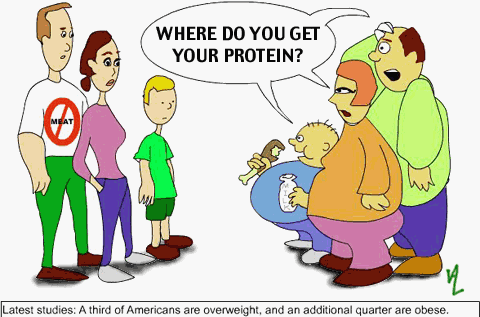
I wanted to open with a cartoon. Sad, possibly even offensive to some people but true. I used to get that question a lot from people who were a lot less fit than me. Also where I used to get my vitamins... Social and environmental factors can be very effective in keeping you conforming to whatever is socially acceptable.
One to remember however, is that not all vegetarians or vegans look like that. It is very possible to be vegan and have a terrible diet. Remember, french fries and potato chips are all vegan. So is a lot of candy and even oreo cookies.
This time I was determined to be a healthy vegan.
Subscribe to:
Posts (Atom)